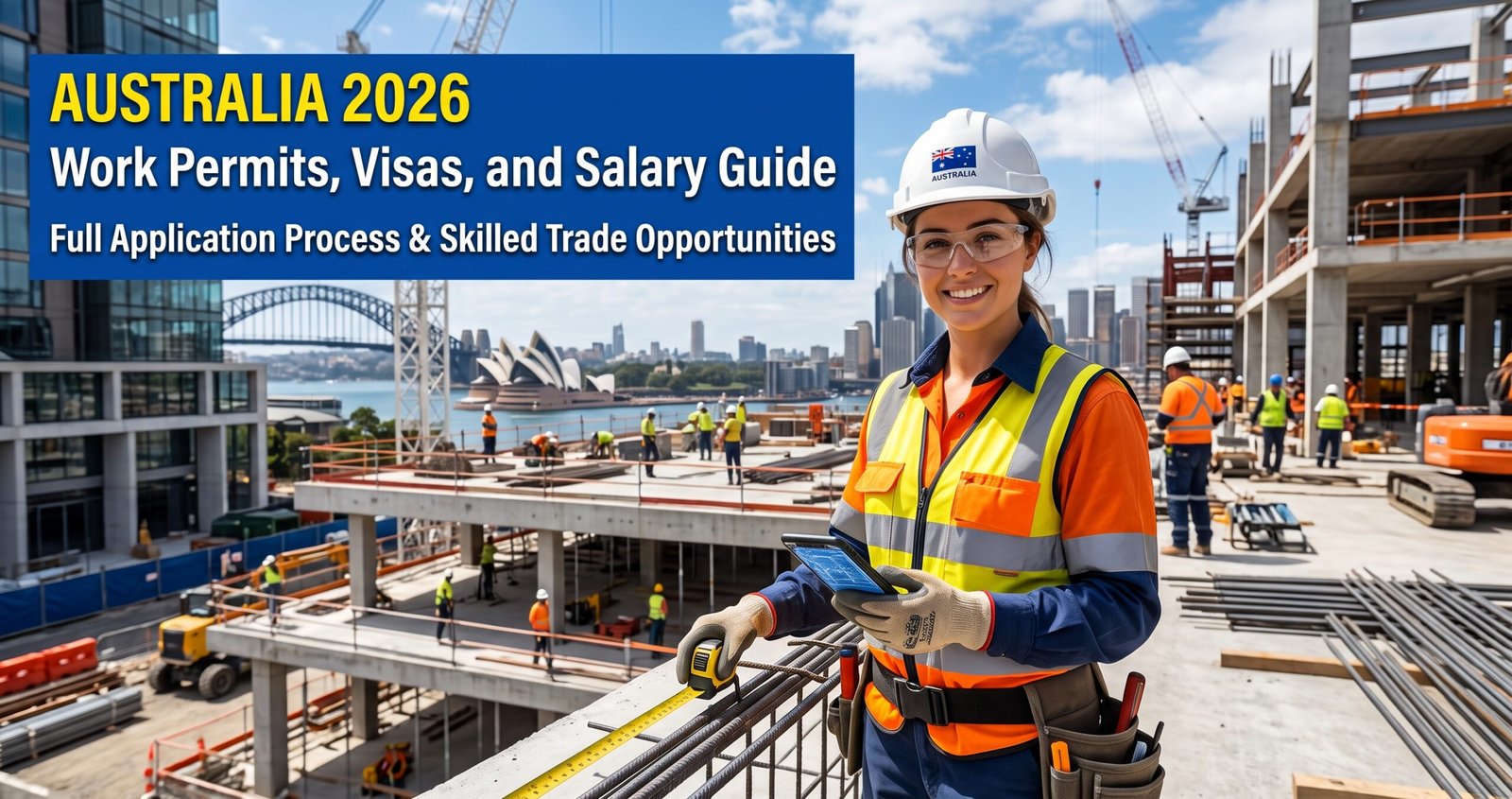
Construction Jobs in Australia 2026: Visas, Salaries & Permits
The construction industry in Australia is booming like it’s never seen before, with a series of huge projects, such as major infrastructure initiatives, renewable energy investments and a national housing agenda that aims to meet the country’s ambitious targets for rapid population increase. But this expansion has been caught up with a very acute shortage of manpower within the country. In response to this lack, the Australian authorities have completely reimagined the Australian visas program for the year of 2026, initiating simplified visa channels that allow competent Tradespeople to land in Australia.
As a tradesperson planning to move to Australia, it is important to gain insight into the legal framework, occupational visas and visa sponsorship. This detailed guide explains all you should know about getting a construction role in Australia in 2026, important certifications you must have, new salary levels and other handy tips on getting in with your construction career safely and on the legal side.
Overview of the Australian Construction Industry in 2026
By 2026, the construction industry is a powerful sector of Australia’s national economy. The construction of hundreds of thousands of new homes to solve the severe housing crisis combined with huge civil engineering works in preparation for the 2032 Brisbane Olympics has not only put demand on skilled physical labor in the construction sector, but it has increased even more since these prime works are delayed from commencing from last year due to the Olympic construction additional cost and expected delays.The need for skilled physical labor in the construction sector is now greater than ever due to the need for many hundreds of thousands of new homes to build to attempt to solve the severe housing crisis and the additional costs and likely delays for Olympic construction works, which are of a massive scale.
Qualified tradespeople cannot be obtained quick enough to get projects done in time. Thus, it is the Australian government’s policy to make skilled migration a major reliance. To deliver this, significant policy outcomes have been agreed for 2026 to enable Australia to become a more desirable place to work and live with appropriate policy measures.
The Skills in Demand (SID) Visa is the new replacement for the previous “Temporary Skill Shortage” (SUB 482) visa. It’s a new type of visa that will ease migration and help attract workers to jobs that require varying skills or pay levels, into three different tiers. The Core Skills Pathway is typically the main pathway for the vast majority of construction workers, where the emphasis is on the trades that are appeared on the Core Skills Occupation List (CSOL).
Key Highlights: What Changed in 2026?
The Department of Home Affairs has made a number of very positive adjustments for overseas construction workers intending to move in 2026 in order to ensure that workers are protected, and to provide long-term stability:
Introduction of the Skills in Demand (SID) Visa: Launch of Skills in Demand (SID) Visa – This visa is a replacement for the Subclass 482 visa, giving tradespeople a maximum of 4 years visa to work in Australia.
Faster Pathway to Permanent Residency (PR): As per the changed visa regulations, under the Faster Pathway to Permanent Residency (PR), or subclass 189 visa holders are now allowed to apply for permanent residency through the Employer Nomination Scheme (Subclass 186) after only 2 years of employment with their sponsor as opposed to 4 years before the subclass 190 visa change.
Updated Salary Thresholds (TSMIT): The Temporary Skilled Migration Income Threshold (TSMIT) has been raised to $79,423 AUD per year for the Core Skills stream, to make sure that overseas workers are not undercut or exploited. This will take effect on July 1, 2026. At a minimum, this amount OR the market salary must be paid to an employee – it is required to the employee by law.
Reduced Work Experience Requirements: Applicants now only need one year of relevant work experience within the last five years to qualify for the SID visa, reduced from the previous two-year requirement.
Increased Worker Mobility: The SID visa also gives job applicants more flexibility in changing jobs if the applicant is not being treated fairly without being required to lose their status as soon as the transfer is initiated.
High-Demand Construction Roles & Salary Expectations
Securing employer sponsorship needs your specific trade to be on the Essential Skills Occupation List (CSOL). Inferior to are some of the most unsympathetically sought-after heroines in 2026, along with typical tasks and baseline salary ranges (note: all supported roles must meet the $79,423 TSMIT least possible).
Carpenter and Joiner
Carpenters are absolutely important for meeting Australia’s residential housing marks.
- Tasks: Formwork, mechanical framing, roofing, and interior fit-outs for domestic and commercial builds.
- Salary Range: $79,423 – $95,000+ AUD (often improved by site payments and overtime).
Electrician
Australia’s transition to renewable energy and smart-home technology has created an massive shortage of qualified electricians.
- Tasks: Connecting wiring systems, renewable energy schemes (solar), industrial maintenance, and safety agreement.
- Salary Range: $85,000 – $110,000+ AUD. Note: Electricians require strict state-specific licensing upon influx before working self-sufficiently.
Bricklayer and Stonemason
Bricklayers are the backbone of the inhabited construction sector, mainly in states like Western Australia and New South Wales.
- Tasks: Laying units, pre-cut stone, and blocks for organizational basics, walls, and decorative qualities.
- Salary Range: $79,423 – $90,000 AUD. Quality and speediness are decidedly rewarded with piece-rate extras on many sites.
Welder, Boilermaker, and Steel Fixer
Heavy industry, removal infrastructure, and profitable high-rises be contingent heavily on fabrication specialists.
- Tasks: Basic steel fabrication, MIG/TIG welding, construing complex nominal drawings, and site ends.
- Salary Range: $80,000 – $100,000+ AUD. (Remote removal or infrastructure developments offer substantial district loadings and budgets).
Plumber
Plumbers are required crosswise housing, civil works, and profitable conservation.
- Tasks: Gas fitting, drain laying, roofing sanitation, and HVAC system additions.
- Salary Range: $80,000 – $100,000+ AUD. Like electricians, plumbers obligation undergo Australian state certifying.
Step-by-Step Guide to Securing a Job and Visa
Moving to Australia is a process that needs careful planning. Use this step by step approach to make your application smooth and HEA compliant.
Step 1: Validate Your Skills (TRA Assessment)
Before an employer is willing to sponsor you, you must demonstrate your skills (TRA Assessment). Applications for any construction trades other than most building and construction related trades should be made to the appropriate Skills Assessment body through Trades Recognition Australia (TRA) The assessment process includes an in-depth paper review of your work and experience and a technical interview and/or technical demonstration.
Step 2: Prepare Your English Language Test
If you’re not from the UK, USA, Canada, NZ or Ireland and will need to prove your English skills. Register for an IELTS or PTE test. This is 5.0 (but better scores are crucial if applying for points-tested visas (189/190)) in all bands for SID visa.
Step 3: Craft an ATS-Friendly Australian Resume
Develop an Australian Resume for the ATS Australian Employers want to see a certain format. Emphasise on your qualifications in terms of trades and your status as an Assessment of Training Recognised (TRA) student, English scores and specific mega project or residential builds that you have worked on. Clearly write at the top: “Eligible for SID Sponsorship – TRA Assessment Completed.
Step 4: Job Hunting and Securing a Sponsor
Job Hunting and Securing a Sponsor Apply for jobs using websites, such as Seek, Indeed, and construction-specific recruitment agencies. You may find job postings which explicitly list “Sponsorship Available” or “482/SID Visa”. Let employers know when you are interested and available to relocate.
Step 5: Employer Nomination and Visa Application
After you receive an offer of employment, your employer (which is a successful Standard Business Sponsor) will submit a nomination on your behalf. They need to demonstrate that they are paying the $79,423 TSMIT. After you’ve been nominated, you submit your visa application, undergo a medical examination and furnish police clearance certificates from your country of origin.
Benefits of Working in the Australian Construction Sector
The advantages of migrating to Australia are incomparable to the rest of the world:
- High Earning Potential: Skilled trade workers will likely have a good middle class income with TSMIT being a safe low starting wages of at least $79,423. Gross earnings can often be in the low six figures thanks to overtime, weekend penalties, and site allowances.
- Superannuation: Australian employers are legally obliged to pay a certain 11+ per cent of your salary into a retirement fund, called Superannuation. This is in addition to your salary.
- Labor Rights and Safety: Australia has some of the world’s harshest safety regulations in the workplace (SafeWork, etc.). Employer responsibility for protective equipment (PPE) conformance is high and union presence guarantees just working conditions.
- Family Inclusion: Immediate family (spouse and children) can accompany as family members, for the purposes of this visa. You will have the full working rights and your children will be able to attend the local school.
- Work-Life Balance: There is more than 4000 hours of annual leave allowable per year (including paid sick leave and public holiday penalties), allowing for a good balance of site work and exploring the lifestyle of Australia.
Expert Advice and Tips for a Successful Application
Navigating international migration is complex. Follow these expert tips to stand out to employers and immigration officials:
- Target Regional Australia: The major cities such as Sydney and Melbourne are very costly. Less competition is actually one of the most significant advantages while focusing on a specific area such as Western Australia, regional Queensland or South Australia. Less competition also means that you can obtain cheaper homes and are eligible to apply for a Subclass 491 visa with a strong path to PR.
- Have an Initial Financial Buffer Moving countries can be costly. Get a start up $5000 – $10,000 AUD ready for costs you might have upfront including flights, rental bond (deposit), breaks in between wages and equipment purchases.
- Use a Registered Migration Agent (MARA): If you’re finding the paperwork of the visa too much to deal with, only use a migration agent who’s registered with the Migration Agents Registration Authority (MARA). A strict code of conduct is enforced as they are legally bound.
- Prepare Your Portfolio: Construction is a Picture Industry. Photograph previous projects, detailed framing work, clean electrical switch boards or great brick placement work. Submit a digital portfolio with your CV, and you’ll reliably establish trust with Australian site managers.
Common Mistakes to Avoid
One wrong move can be thousands of dollars or even result a visa refusal. Don’t make these kinds of mistakes:
- Falling for “Guaranteed Job” Scams: The claim by a recruiter or agent that they have a guaranteed job is a scam and should never ask you to pay a fee for them to place you in a visa sponsor position. It is the employer’s responsibility to fully cover the sponsorship and nomination fee pursuant to the law. If an agency would give you a visa if you pay money, that agency is a scam.
- Skipping the Skills Assessment: Not doing the Skills Assessment: Interviewing without conducting the checklist is a bad strategy for securing a job application sponsorship. A round of testing will take time to walk through 3-4 months from beginning to end, and employers don’t wait for such a lengthy time while you conduct it on your own. Be prepared with your TRA Number.
- Underestimating the English Requirement: A lot of skilled tradespeople do not prepare for the English requirement and end up failing to get their visas approved simply because they thought conversational English would suffice them because it is not practised for the specific test they encountered.
- Accepting Sub-standard Pay: The employers giving you sponsorship are in breach of the law if they ask you to take the lower TSMIT ($79,423). No, if they ask if you are not sick of their tactics of exploitation and visa cancellation.
FAQs
Do I absolutely need a White Card before applying for jobs from overseas?
Answer: No, you do not essential it to smear. However, it is a mandatory legal obligation before you can step onto a building site in Australia. Most travelers complete the exercise (which takes one day) immediately upon arriving in the country already their first shift.
Can I apply for the Skills in Demand visa if I am over 45 years old?
The SID (temporary) visa does not have a severe maximum age limit. However, the following transition to Permanent Position (Subclass 186) generally wants applicants to be lower than the age of 45 at the time of the PR request, though some exceptions exist for high-income employees or specific labor arrangements. Consult a MARA representative for age-related PR strategies.
How much will the Skills in Demand visa cost me in 2026?
As of 2026, the base visa application responsibility for the primary candidate is $4,015 AUD, with additional costs for reliant on spouses ($4,015) and children lower than 18 ($1,005). Remember, this is just the visa fee; you obligation also factor in costs for health orders, police checks, English tests, and the TRA skills taxation.
Will my employer pay for my relocation flights and housing?
This is entirely reliant on on the employer. While not officially required, various large construction and mining companies offer relocation suites that include flights, provisional accommodation (2-4 weeks), and tool grants to attract top talent. You must negotiate this throughout the interview stage.
Final Thought
Getting a legal work visa for construction in Australia for 2026 is a well-organised, but very fulfilling process. The government has recently undertaken a project to overhaul the old 482 class visa program into the new, streamlined Skills in Demand (SID) visa program, which will enable skilled tradespeople to qualify for significantly better job conditions (higher minimum salary thresholds at $79,423 TSMIT), better workplace protections, and faster visa processing (twice as fast until the Permanent job conditions are implemented) which allows them to progress through to Permanent Residency in just 2 years.
Australia’s construction sector provides not only excellent career longevity, environment-friendly working practices and safety regulations and a lifestyle hard to beat. Whether you have an upcoming interview or are hoping to get off the waitlist for family visa applications, you will be in a strong position to appeal to best employers in Australia by completing your TRA assessments, preparing for your English assessments, and being family-ready for necessary requirements such as a White Card. Take the time to put fully in place the document, do not take shortcuts and make one first step in a prosperous future down under.