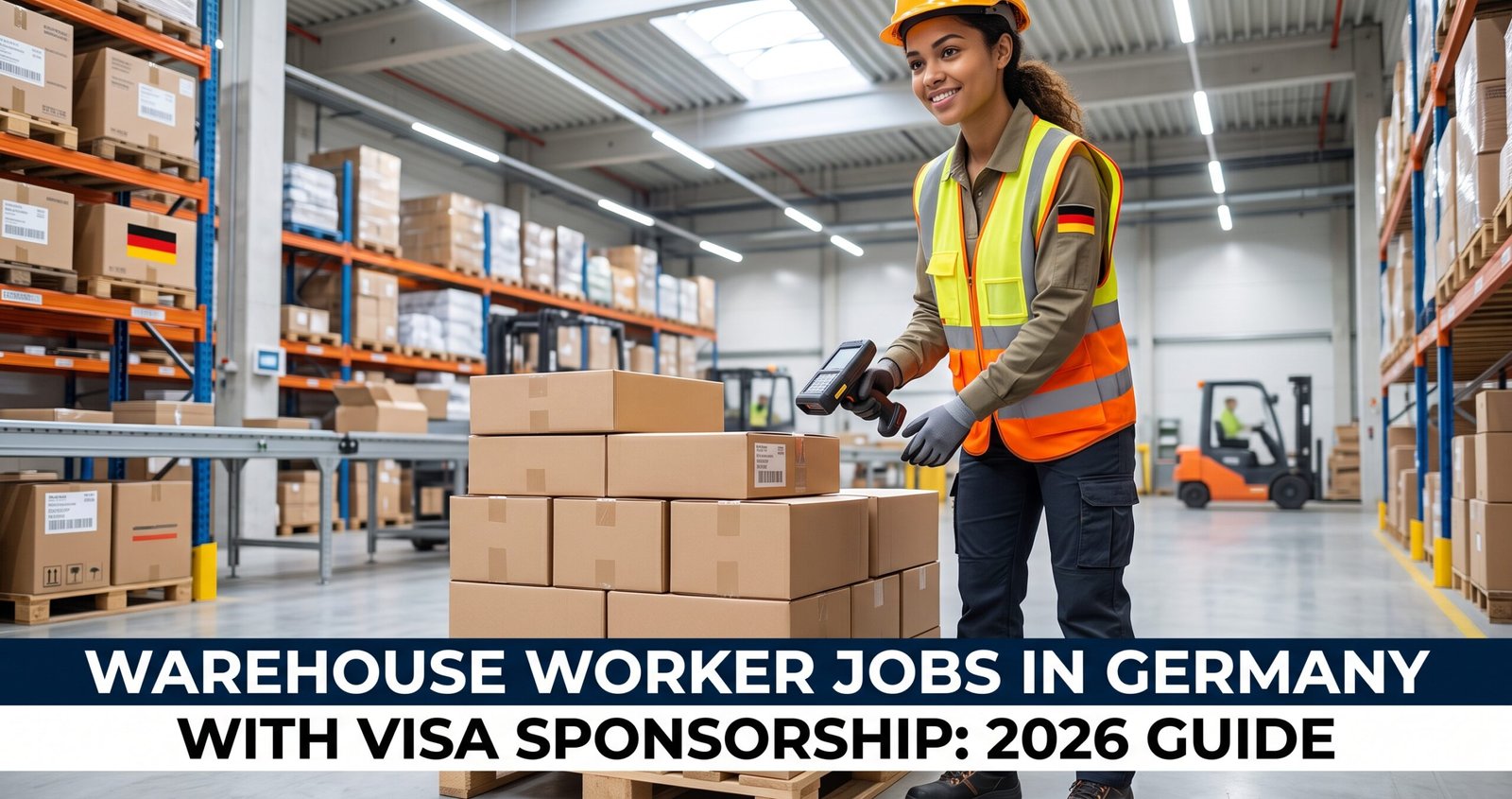
Warehouse Worker Jobs In Germany with Visa Sponsorship: 2026 Guide
Looking to move to Europe and establish a career and life of productive forays? The securing of warehouse worker jobs in Germany with visa sponsorship has emerged as one of the more viable ways of international workers entering the European labour market. The need for logistics workers, packers and forklift operators have grown increasingly in recent years, especially in Germany due to its position as Europe’s biggest logistics and supply chain based country.
But having a smoothly-functioning employment and immigration system in Germany can be daunting. Therefore, numerous individuals looking for work visas are unsure where to locate a genuine employer who will sponsor an H1N1 visa, which immigration laws they are required to follow, and how to steer clear of scam visa recruitment firms. Recent changes to German laws on immigration and employment, such as the New Skilled Immigration Act and the Chancenkarte (Opportunity card), provide new and less cumbersome paths to live and work in Germany.
Overview of the German Logistics Industry
Germany boasts the largest and most advanced logistics market in Europe. With its geographic centrality, it is the main distribution hub between the west and the east. Big players like DHL, DB Schenker, DP World, Kühne + Nagel or Amazon build a large fulfillment centre in the respective regions such as Hamburg, Munich, Berlin or Frankfurt.
Germany’s logistics industry is more than just a system for delivering boxes, it’s a very modernised business. Today’s German warehouses are heavily afflicted with cutting-edge technologies, such as the Internet of Things (IoT), artificial intelligence (AI), machine learning, and robotics. Automation is growing, but there is a strong need for people to be on board to sort, pack and operate machines. As a result, blue collar workers are continuously in short supply.
Key Highlights: Salary and Work Conditions
When looking for warehouse worker jobs in Germany with visa sponsorship, it’s essential to know what to anticipate regarding salary and everyday work life. Germany brings with it tough and stringent labor laws and regulations that apply to domestic workers as well as foreign workers, ensuring equitable wages and a safe working environment
Competitive Salary and Minimum Wage
Germany has a legal minimum wage that is enforceable for all employee irrespective of citizenship. The minimum wage for 2024/2025 is €12.41 per hour and a number of logistics companies is paying an entry level of €13.00 to €14.00 per hour.
- Monthly Earnings: A full-time warehouse hand (working about 160 hours per month) can guess a gross regular salary ranging from €2,000 to €2,800, conditional on their experience, location, and the exact shift they work.
- Net Income: After assessments and social security assistances, the net take-home pay typically ranges among €1,500 and €1,900 per month.
- Shift Allowances: Occupied night shifts, Sundays, or public outings often permits you to a tax-free shift extra (Zuschläge), which can suggestively increase your general earnings.
Standard Working Hours
A normal full-time employment agreement in Germany regularly involves 38 to 40 hours per week. Warehouse jobs normally operate on a shift system, which may embrace early morning shifts, late early afternoon shifts, and night shifts. Employers requirement adhere to the German Occupied Hours Act (Arbeitszeitgesetz), which severely limits eventually and obligations adequate rest periods concerning shifts.
Workplace Safety and Environment
German warehouses are popular for their severe adherence to job-related health and safety standards. Workers are providing with high-quality special protective equipment (PPE), such as steel-toed boots and high-visibility vests. Regular safety working out is compulsory, and union representation (such as Verdi) confirms that workers’ rights are always upheld.
Step-by-Step Guide to Securing a Job and Visa
Locking a warehouse job in Germany from overseas requires a organized approach. Follow these precise stages to maximize your probabilities of achievement.
Step 1: Prepare a German-Style Application
German employers guess a very specific arrangement for job requests. You obligation prepare a Lebensraum (CV/Resume) and a Anschreiben (Protection Letter).
- Your CV should contain a expert photo, your date of birth, population, and a clear timeline of your work experience.
- Translate your CV addicted to German if conceivable. Even if relating for an English-speaking warehouse, a German CV shows perseverance.
- Collect all your orientation letters (Arbeitszeugnisse) from preceding employers.
Step 2: Search for Verified Employers
Do not depend on on random social media markers promising direct visas. Use real, government-backed, or highly honest job portals:
- Make it in Germany: The allowed German government portal for international skilled professionals.
- Bundesagentur für Arbeit (Jobbörse): The sanctioned job board of the German employment activity.
- EURES: The European Job Mobility Portal.
- Company Websites: Apply right on the occupation pages of logistics giants like DHL, Hermes, DPD, GLS, and Amazon Germany.
Step 3: Ace the Interview and Get the Contract
If your side view matches their needs, the employer determination invite you for an online interview (regularly via Microsoft Teams or Zoom). Be set to answer questions almost your physical suitability, willingness to work changes, and reliability. Once you documentation, the employer resolve issue a formal Employment Agreement (Arbeitsvertrag).
Step 4: The Federal Employment Agency Approval
Before you can relate for your visa, your future employer requirement submit your employment agreement to the Federal Employment Intervention (BA) for pre-approval (Vorabzustimmung). The BA checks if your salary competitions the regional values and whether the job chances all legal criteria. This development usually takes 2 to 4 weeks.
Step 5: Apply for the National Work Visa (D-Visa)
Once your employer directs you the pre-approval certificate, you must book an selection at the German Embassy or Deputation in your home country. You will requirement to bring:
- Your valid passport.
- The creative employment agreement.
- The pre-approval document from the BA.
- Proof of health protection.
- Your CV and any important certificates.
Step 6: Arrive in Germany and Register
After your visa is accepted, you can collapsible to Germany. Within your original two weeks, you must index your residential address at the local inhabitants’ office (Bürgeramt). In conclusion, you will apply for your physical habitation permit card (Aufenthaltstitel) at the limited immigration office (Ausländerbehörde).
Benefits of Working in Germany
Selecting Germany as your work purpose offers assistances that go far outside a monthly pay. The German social security organization is highly protective and designed to confirm a high quality of life for all populations.
Comprehensive Healthcare
As an employee in Germany, you are mechanically registered in the statutory health protection system (Gesetzliche Krankenversicherung). Your employer earnings half of your regular premium, and you pay the other half. This protection covers limitless doctor visits, hospital stays, prescription medications, and dental check-ups for you and your charges.
Paid Vacation and Sick Leave
German law guidelines a slightest of 20 paid vacation days per year for a 5-day workweek, though most logistics corporations offer between 24 and 30 paid days off every twelve months. Additionally, if you fall ill, your employer is officially obligated to continue giving 100% of your salary for up to six weeks.
Pathway to Permanent Residency
Working as a warehouse operative on a valid habitation permit counts towards your eternal residency (Niederlassungserlaubnis). Typically, after existing and working in Germany for 5 years (paying taxes and pension donations) and achieving a B1 level in the German language, you can relate for permanent position. Recent law vagaries even permit some workforces to apply for social responsibility after just 5 years.
Family Reunification
Contingent on the type of work visa you hold, your revenue, and the size of your bed-sitter, you may be qualified to bring your next of kin and minor children to Germany. Your other half will generally be granted full occupied rights upon arrival.
Common Mistakes and How to Avoid Scams
The demand for European work visas has formed a thriving black marketplace for scammers. It is critical to defend yourself when removing for warehouse worker jobs in Germany with visa sponsorship. Satisfy recite these warnings carefully.
Never Pay for a Job Offer
It is strictly illegal in Germany for an employer or a conscription agency to charge a applicant a fee for a job offer or a work contract. Legitimate recruitment agencies are paid by the employer, not by the job explorer. If celebrity asks you to pay hundreds or thousands of big one for a “guaranteed visa” or an “employment letter,” it is a scam.
Beware of Unrealistic Promises
No agency can guarantee a 100% visa approval. The final decision always rests with the German Embassy and the Central Employment Intervention. Avoid websites or social media pages that use aggressive clickbait like “Move to Germany Tomorrow” or “No Wants Needed.”
Verify the Employer
Scammers regularly use the names of actual companies like DHL or Amazon to trick victims. Always verify the communication address of the person calling you. A real recruiter from DHL will email you from an address conclusion in @dhl.com, not from a free Gmail or Yahoo account. Cross-reference the job offer by inspection the company’s official occupation page.
Entering on a Tourist Visa
Do not transportable to Germany on a Schengen Tourist Visa (Type C) with the determination of converting it into a work visa. German law regularly prohibits replacing a tourist visa into a work visa from within the country. You must relate for the correct National Work Visa (Type D) from your home country formerly you travel.
Tips and Expert Advice for Your Application
To opinion out in a highly inexpensive applicant pool, reflect these professional tips:
- Invest in Language Learning: Even if the job announcement says “English speaking,” start learning German directly. Use apps like Duolingo, Babbel, or join in a local Goethe-Institut. Holding an A2 Goethe documentation will put your submission at the top of the pile.
- Tailor Your Cover Letter: Do not direct a generic cover letter. Mention the exact company you are smearing to, explain why you want to work in logistics, and high point your reliability, reliability, and physical capability.
- Be Transparent About Your Visa Status: On your CV, undoubtedly state your recent nationality and write: “Looking for an employment agreement to apply for a German Work Visa in Section 19c AufenthG.” This shows employers that you comprehend the legal process, which decreases their hesitation to employ you.
- Consider Regional Hubs: Don’t just attention on major cities like Berlin or Munich, where housing is extremely expensive and occasional. Look for warehouses in sections like North Rhine-Westphalia (NRW), Hesse, or Baden-Württemberg, where considerable industrial commons are located, and the charge of living is more practicable.
FAQs
Do I need a university degree to get a warehouse job in Germany?
No, a university degree is not compulsory for normal warehouse roles like selection, packing, or general support. However, if you keep vocational training in logistics, you will be suitable for higher-paying roles and possibly benefit from closer visa processing routes.
Will the employer pay for my flight and accommodation?
Generally, no. Most German companies will support your visa request by so long as the necessary work agreement and administrative support, but the costs of journeys, visa fees, and initial housing are regularly the responsibility of the employee. Some employers can offer temporary housing support, but this is an concession, not the rule.
Can I apply for the Chancenkarte (Opportunity Card) if I only have a high school diploma?
No. The Chancenkarte strictly wants you to have at least two years of state-recognized vocational training or a university mark from your home country, along with evidence of financial stability and language services.
Q4: How long does the visa sponsorship process take?
Once you have the employment agreement, securing support from the Federal Employment Agency and dispensation the visa at the embassy typically takes amongst 8 to 14 weeks, depending on the volume of requests at your local German mission.
Final Thought
Securing warehouse worker jobs in Germany with visa sponsorship is a faithful and highly rewarding goal, provided you method the process with industry, honesty, and homework. Germany’s logistics sector is booming, and the government has passively updated immigration laws, like the introduction of the Chance Card and streamlined Section 19c approvals, to welcome foreign talent.
To be successful, you must focus on building a expert CV, acquiring basic German language skills, and completely applying through real channels. Avoid the invitation of quick fixes or agencies challenging upfront fees. By following the step-by-step guide sketched in this article, you will be well on your technique to navigating the German employment background, securing a reasonable job offer, and early a stable, successful new section in the heart of Europe.